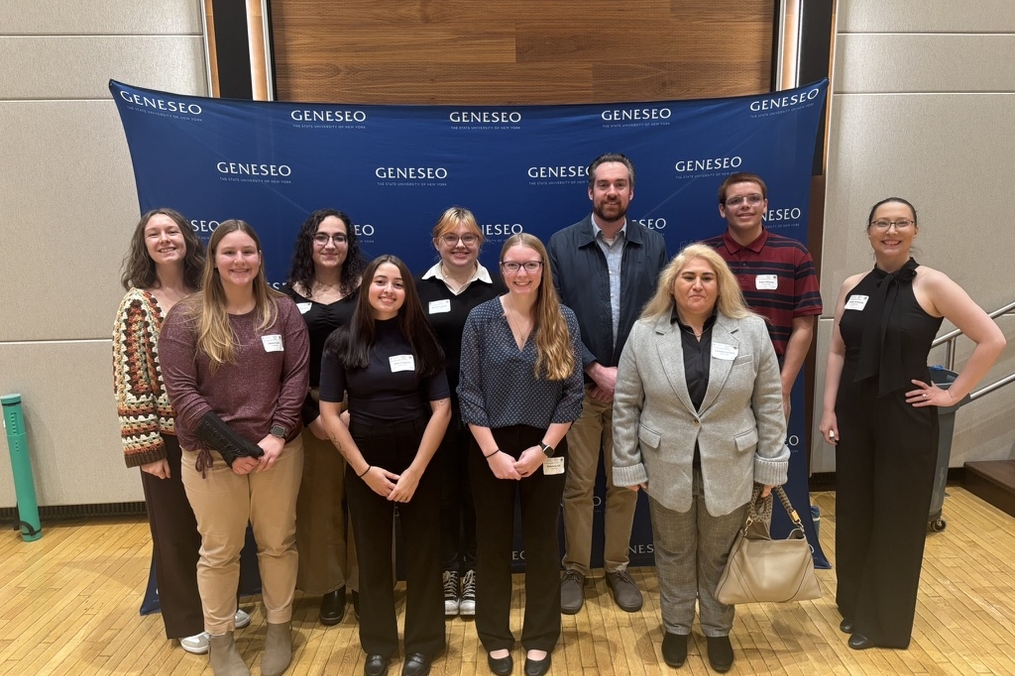
Six Keuka College science students stepped into the role of practicing researchers this fall, presenting seven posters at the 51st annual Rochester Academy of Science (RAS) Conference, held this past November at SUNY Geneseo. The event, which draws participants from more than 30 colleges across the region, offered the students a chance to share their work, build professional connections, and experience the collaborative nature of scientific discovery.
For many, it was their first major external conference. For all, it was a capstone moment of months – or even years – of hands-on research conducted in Keuka College’s growing forensic science and biochemistry labs.
Keuka College has participated in the conference for a decade, and its presence continues to expand.
This year, the College sent six student presenters: seniors Alana Modugno, Jade Scaptura, and Dylin Whitney; juniors Gabriella “Gabbi” Hall and Aurora Lawton; and sophomore Olivia Frank. The students were supervised by faculty mentors, Associate Professor of Biology Dr. Luciana Cursino, Instructor of Biology Jessica Katolik, and Assistant Professor of Chemistry Dr. Andrew Geragotelis.
Keuka College has also been invited to host the conference in 2027, an honor that requires Board of Trustees approval and reflects the College’s growing reputation for high-quality undergraduate research.
Hands-On Inquiry, Real-World Questions
The students’ projects spanned a wide range of scientific disciplines, from forensic anthropology and biochemistry to computational chemistry and museum studies. But a common thread ran through the work: each project aimed to answer real questions with real impact.
Senior Dylin Whitney, a biology major, presented his research on sex estimation using human femurs from the College’s forensic collection. His work involved months of literature review, precise bone measurements using digital tools, and in-depth statistical analysis.
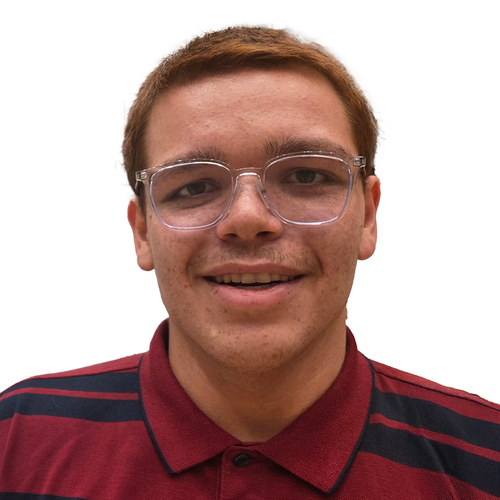
“I gained a deeper knowledge of forensic anthropology as a whole. Now I might want to pursue this field. I’m definitely more interested in it.”
Junior Aurora Lawton, a psychology major concentrating in clinical counseling, focused her project on age estimation of infant and adolescent skulls, a task requiring meticulous attention and compassion. With no biology background at the start, Aurora taught herself juvenile osteology (the study of bones) and worked closely with faculty to fine-tune her findings for the conference.
“I learned terms that I’ve never heard of before and used tools that I never would have imagined using,” she said.
Her project also shifted her long-term goals. She’s now considering graduate programs in museum science after discovering a passion for cataloging and archival work. She has also taken on the enormous task of teaming up with Laboratory Coordinator Barbara Demjanec to rebuild the College’s digital catalog of its 875-piece bone collection, work that had to be restarted after a technical disruption.
“We want to make sure these individuals aren’t forgotten,” Aurora said. “And the hope is, after we’re done with the bone section, it will progress to the rest of the catalog and for all the other specimens.”
International Collaboration
Senior Jade Scaptura presented not one but two posters: one in forensic anthropology and one in biochemistry. Her morphometric analysis focused on sex estimation using measurements of the lower jawbone. But it was her biochemical research that sparked international collaboration.
Working with Dr. Cursino and Dr. Geragotelis, Jade has been isolating and identifying proteins in teeth to determine an individual’s sex. This advanced project involves high-tech tools and a partnership with Dr. Robert Layfield of the University of Nottingham, whose published work inspired the project.
After Jade and Pro. Katolik reached out to Dr. Layfield, he agreed to assist by providing antibodies for their tests and performing analyses on the College’s protein samples.
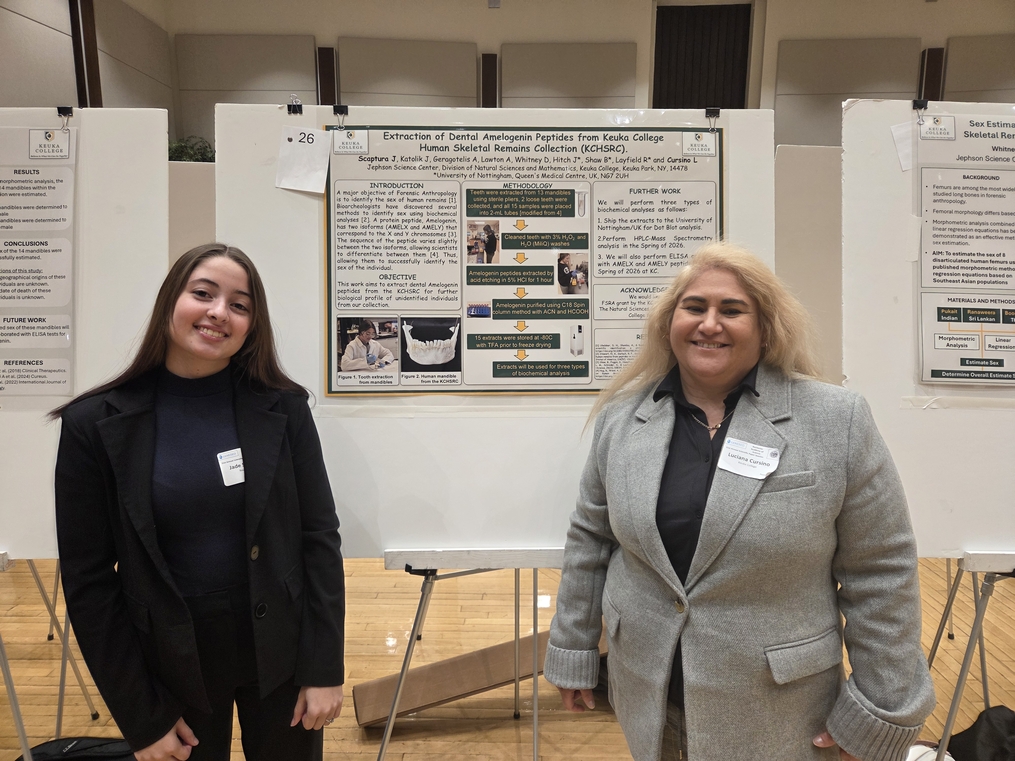
Senior Jade Scaptura poses near one of her two separate posters with Dr. Luciana Cursino.
“I went into this just wanting a research credit,” Jade said. “But working alongside Jess (Kotolik), she and I both care deeply about building the biological profiles because we don't know if they consented to us experimenting on them. We want to return enough of their identity so they can be honored and laid to rest. I definitely learned to be passionate and empathetic about what I’m doing.”
Jade now plans to pursue a Ph.D. in forensic anthropology.
Junior Gabbi Hall presented a poster on a computational chemistry project examining how a particular anesthetic interacts with ion channels in the human body. The coding-based project has been going on for three semesters so far.
Though the work is meticulous, Gabbi said, it aligns directly with her career aspirations in surgery.
“I’m looking into surgery in the medical field and understanding how this anesthetic interacts with the body is interesting to me,” she said. “It directly impacts the career that I'm looking into.”
At the conference, Gabbi’s work garnered attention from researchers familiar with related chemical modeling techniques. Their feedback led her and Dr. Geragotelis to a new scholarly resource that will help advance the project, something they would not have encountered without attending.
Learning Beyond the Lab
The students’ faculty mentors emphasized the importance of presenting at conferences as a key part of scientific training.
“Science never happens in a bubble,” said Prof. Katolik, project manager of the forensic science lab. “When our students present externally, they become part of the scientific community. By going to conferences, they’re no longer just, as I call them, my ‘science babies;’ they’re scientists.”
Dr. Geragotelis added that presenting at a professional conference requires both scientific mastery and personal confidence.
“Standing in a room full of researchers and discussing your work takes courage,” he said. “To see the growth from where they started to where they stood on presentation day – it’s remarkable.”
The students said the conference didn’t just validate their work; it helped them build networks and envision their futures.
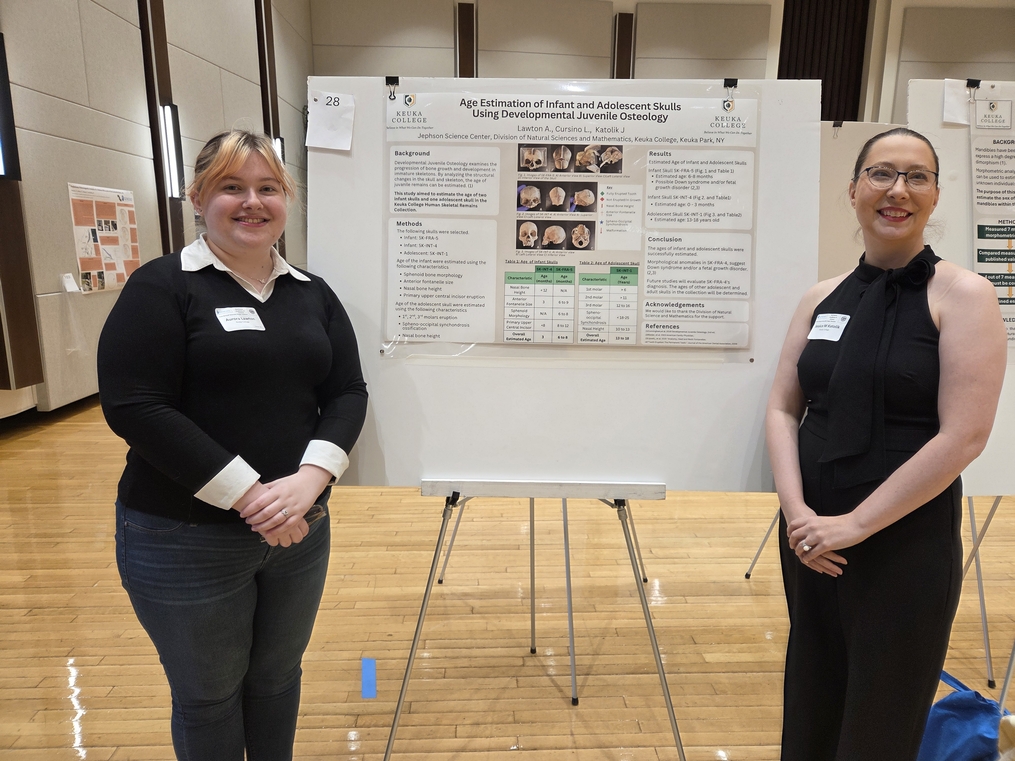
Junior Aurora Lawton stands tall near her poster, along with her adviser, Instructor of Biology Jessica Katolik.
Jade spoke with six attendees during her session, including a student who asked for updates on her findings. Dylin, initially nervous, found that engaging with visitors boosted his confidence. Aurora noted that among 113 posters, only four – all from the Keuka College contingent – focused on human remains, drawing significant curiosity.
Each student left with new questions, new connections, and new confidence in their ability to contribute to scientific progress.
The following Keuka College students took part in the 51st annual Rochester Academy of Science (RAS) Conference:
Alana Modugno ’25 (Biology major who graduated in December 2025) Advisers: Instructor of Biology Gylla MacGregor, Associate Professor of Environmental Science Corey Palmer
Jade Scaptura ’26 (senior Biology major) Adviser: Associate Professor of Biology Dr. Luciana Cursino
Aurora Lawton ’27 – (junior Psychology major with a path in clinical pathology) Advisers: Instructor of Biology Jessica Katolik and Laboratory Coordinator Barb Demjanec
Dylin Whitney ’26 – (senior Biology major– forensic chemistry-forensic laboratory- morphemetic) Advisers: Jessica Katolik and Corey Palmer
Gabriella “Gabbi” Hall ’27 (junior Biology major with minors in mathematics and childhood family studies) Adviser: Assistant Professor of Chemistry Dr. Andrew Geragotelis
Olivia Frank ’28 – (sophomore Biology major) Adviser: Dr. Luciana Cursino